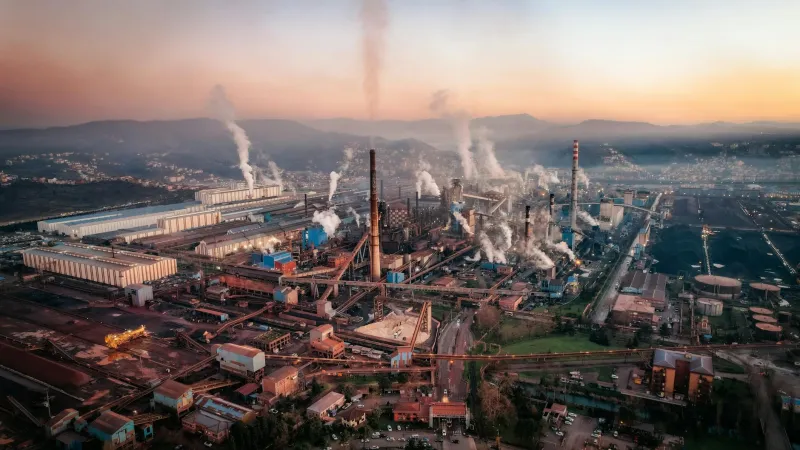
In St. John the Baptist Parish, Louisiana, the cancer risk from air pollution is 800 times the national average. Children in this predominantly Black community, nestled between petrochemical plants along the Mississippi River, develop respiratory problems at rates that would trigger federal emergency declarations anywhere else. Yet for decades, this 85-mile corridor known as "Cancer Alley" has operated as an unofficial sacrifice zone — a place where the environmental costs of America's fossil fuel economy are quietly absorbed by communities with the least political power to resist.
St. John Parish represents just one node in a vast network of environmental sacrifice zones that stretch across the United States, from the coal ash ponds of North Carolina's Black Belt to the oil refineries surrounding Latino neighborhoods in Houston. These are the places where America's energy economy extracts its profits while externalizing its deadliest costs onto the communities least equipped to fight back.
The Geography of Environmental Injustice
The pattern is as predictable as it is morally indefensible. According to EPA data, communities of color are exposed to 40% more particulate matter pollution than white communities, while low-income areas face 35% higher exposure rates. This isn't coincidence — it's the result of decades of deliberate policy choices that prioritized industrial profits over human health.
The statistics paint a stark picture of environmental apartheid. Toxic waste facilities are 56% more likely to be located in communities of color. Children in these areas develop asthma at twice the national rate. Life expectancy in the most polluted zip codes can be 10-15 years shorter than in the cleanest ones, a gap that rivals the health disparities between entire countries.
Consider the Navajo Nation, where uranium mining for nuclear weapons left 500 abandoned mines and contaminated groundwater that still poisons families today. Or Detroit's 48217 zip code, where residents live surrounded by oil refineries, steel plants, and waste incinerators, breathing air so toxic that childhood asthma hospitalization rates are five times the state average.
The Enforcement Gap
Environmental laws exist on paper, but enforcement tells a different story. Under the Trump administration, EPA enforcement actions dropped by 70%, with the steepest declines in environmental justice communities. Even under more sympathetic administrations, penalties for violations in majority-minority areas average 46% lower than those in white communities, according to research by the University of Michigan.
This enforcement gap isn't accidental — it reflects the political reality that polluting industries face fewer consequences when their victims lack political power. When ExxonMobil's Beaumont refinery in Texas released 363,000 pounds of pollutants during Hurricane Harvey, affecting a predominantly Latino community, the company paid a $20 million fine — less than the corporation earns in two hours of revenue.
Meanwhile, community advocates like Robert Bullard, the "father of environmental justice," have spent decades documenting how regulatory agencies systematically undervalue the health and lives of minority communities. EPA risk assessments routinely use property values as proxies for community impact, ensuring that pollution in low-income areas appears less costly to address than identical contamination in wealthy neighborhoods.
The False Promise of Market Solutions
Industry defenders argue that market forces naturally address environmental problems as communities become wealthier and demand cleaner air. This narrative conveniently ignores how environmental racism created these disparities in the first place, while assuming that poisoned communities can simply move away — ignoring the reality that environmental contamination often destroys the property values that would enable such mobility.
The market solution also fails to account for cumulative impacts. While individual facilities might meet legal pollution limits, communities hosting multiple industrial sources face combined exposures that far exceed safe levels. In Commerce City, Colorado, Latino residents live within two miles of 23 major industrial facilities, creating a toxic cocktail that no single regulation addresses.
The Health Toll
Behind every pollution statistic lies human suffering that demands moral reckoning. In Mossville, Louisiana, a historically Black community founded by freed slaves, residents showed blood levels of dioxin — a cancer-causing chemical — three times the national average. The source: a nearby chemical plant that the company eventually bought out the entire community to avoid liability.
Dr. Beverly Wright, who has studied environmental health in Louisiana for decades, documents how pollution exposure begins before birth. Pregnant women in petrochemical corridors show elevated levels of toxic chemicals that cross the placental barrier, programming health problems that will follow children throughout their lives. "We're seeing multi-generational impacts," Wright explains, "where environmental racism becomes literally encoded in DNA."
The COVID-19 pandemic revealed how environmental sacrifice zones become mortality multipliers. Communities with higher air pollution experienced COVID death rates 15% above the national average, as decades of respiratory damage left residents uniquely vulnerable to a respiratory virus.
Climate Promises, Environmental Justice Realities
As America belatedly embraces climate action, the risk of creating new sacrifice zones looms large. Lithium mining for electric vehicle batteries threatens Indigenous water sources in Nevada. Renewable energy projects can displace rural communities without adequate consultation. Carbon capture technology, heavily subsidized in recent climate legislation, could extend the lifespan of fossil fuel facilities in environmental justice communities.
The Biden administration's Justice40 initiative promises that 40% of clean energy investments will benefit disadvantaged communities — but implementation remains patchy. Of the $370 billion in climate investments from the Inflation Reduction Act, tracking mechanisms to ensure environmental justice communities receive promised benefits remain largely theoretical.
The Organizing Response
Communities aren't accepting sacrifice zone status quietly. In St. James Parish, Louisiana, Sharon Lavigne and RISE St. James successfully blocked a $9.4 billion petrochemical complex through sustained organizing and legal challenges. In Detroit, the East Michigan Environmental Action Council has forced polluters to install better monitoring equipment and pay for community health studies.
These victories demonstrate that environmental justice isn't just about stopping bad projects — it's about asserting that all communities deserve the same environmental protections that wealthy areas take for granted. As Lavigne puts it: "We have the same red blood running through our veins as people in other communities. Why should we be treated differently?"
Toward True Environmental Justice
Addressing sacrifice zones requires more than technological fixes or market mechanisms — it demands confronting the structural inequalities that make environmental racism profitable in the first place. This means strengthening enforcement in overburdened communities, ensuring cumulative impact assessments for new projects, and centering community voices in environmental decision-making.
It also requires acknowledging that climate solutions that perpetuate environmental injustice aren't solutions at all. A green transition that leaves Cancer Alley behind isn't progress — it's gentrification in environmental drag.
The Moral Imperative
Environmental sacrifice zones represent a fundamental contradiction in American democracy: the idea that some communities can be written off as acceptable losses in pursuit of broader economic goals. This logic doesn't just poison air and water — it poisons the democratic principle that all lives have equal value.
As Congress debates infrastructure spending and climate policy, the question isn't just whether America can build a clean energy economy, but whether it can build one that doesn't replicate the environmental apartheid of the fossil fuel era. The communities living in today's sacrifice zones have already paid more than their share — the time has come for the rest of America to bear the costs of true environmental justice.