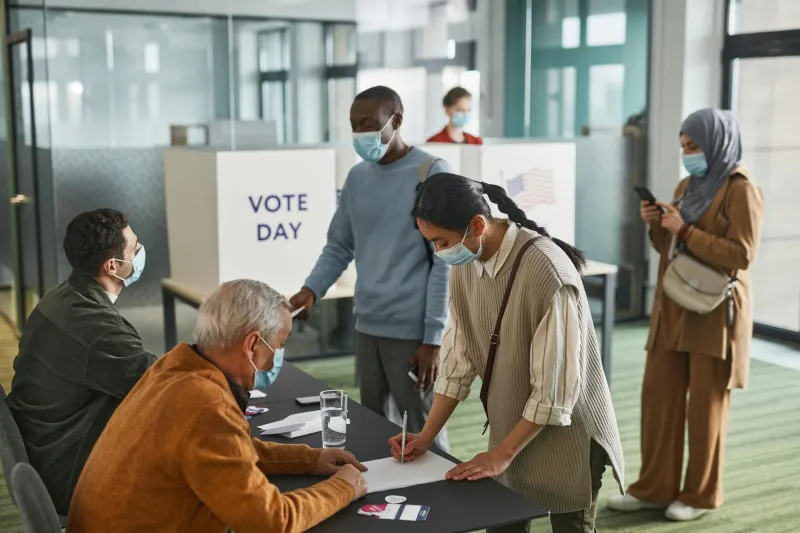
Democracy in America comes with a price tag that millions of working families simply cannot afford. Across the country, a web of restrictive voting laws has created what amounts to a poll tax by another name — forcing citizens to spend money they don't have, take time off work they can't afford to lose, and navigate bureaucratic obstacles designed to discourage participation rather than encourage it.
Since the Supreme Court gutted the Voting Rights Act in Shelby County v. Holder (2013), states have closed more than 1,600 polling places, with Texas leading the charge by shuttering 750 locations. These closures disproportionately target communities of color: counties with the largest Black and Latino populations saw polling places reduced by 20% compared to just 3% in majority-white areas, according to analysis by the Leadership Conference Education Fund.
The Hidden Costs of 'Free' Elections
Voter ID laws, now enacted in 36 states, exemplify this democracy tax most clearly. While proponents claim these measures prevent fraud — despite documented voter impersonation rates of 0.0003% — the real-world impact falls heaviest on those least able to bear it.
Obtaining a "free" voter ID often requires documents that cost money: birth certificates ($10-$50), passports ($130-$165), or driver's licenses ($20-$90). For the 21 million Americans without government-issued photo ID — disproportionately elderly, low-income, and minority citizens — these fees represent a significant barrier. Add transportation costs to reach DMV offices (often located far from public transit), plus wages lost for time off work, and the total can easily exceed $100.
Consider Maria Santos, a home healthcare worker in rural Texas, who must choose between losing a day's wages ($96) to obtain voter ID or missing the election entirely. This isn't theoretical hardship — it's systematic disenfranchisement disguised as election security.
The Purge Machine
Voter registration purges have accelerated dramatically, with states removing 17 million voters from rolls between 2016-2018 alone — a 33% increase from the previous cycle. Georgia's "exact match" law removed 53,000 registrations in 2018, with 70% belonging to Black voters. Ohio's aggressive purging system, upheld by the Supreme Court in Husted v. Randolph Institute, removes voters simply for not participating in recent elections.
These purges create a cruel irony: the more difficult states make voting, the more citizens they can justify removing for not voting. It's a feedback loop that systematically shrinks the electorate while claiming to protect election integrity.
Time as Currency
The democracy tax isn't just financial — it's temporal. Polling place closures have created hours-long wait times in communities of color, effectively requiring citizens to spend their most precious resource: time. In 2020, voters in predominantly Black precincts waited an average of 29 minutes compared to 6 minutes in white precincts.
For hourly workers without paid leave, a two-hour wait to vote can mean choosing between civic duty and rent money. This time penalty hits service workers, retail employees, and gig economy participants hardest — the very Americans whose economic interests are most directly affected by election outcomes.
The Conservative Counter-Narrative
Supporters of restrictive voting laws argue these measures prevent fraud and ensure election integrity. They point to public polling showing majority support for voter ID requirements and frame opposition as partisan obstruction.
But this argument crumbles under scrutiny. Documented cases of voter impersonation — the only fraud prevented by ID laws — are vanishingly rare. The Heritage Foundation, a conservative think tank, has documented just 1,412 instances of voter fraud resulting in convictions since the 1990s across billions of votes cast. Meanwhile, studies consistently show these laws reduce turnout by 2-3 percentage points, affecting hundreds of thousands of eligible voters.
The real question isn't whether Americans support election security in theory, but whether they support policies that demonstrably reduce participation while solving virtually no documented problems.
The Human Cost of Disenfranchisement
Behind every statistic lies a fundamental question of democratic values. When Desmond Meade, a formerly incarcerated Floridian, led the campaign to restore voting rights to 1.4 million citizens with felony convictions, the state legislature responded by requiring payment of all fines and fees — effectively creating a wealth test for civic participation.
The result: an estimated 775,000 Floridians remain disenfranchised not because of their conviction, but because of their economic status. In a state where elections are routinely decided by tens of thousands of votes, this represents a massive distortion of democratic will.
Democracy's Crossroads
The democracy tax reveals a deeper truth about American politics: when participation becomes a privilege rather than a right, policy outcomes inevitably favor those with the resources to navigate an increasingly complex system. Wealthy communities retain convenient polling places while working-class neighborhoods lose theirs. Suburban professionals can afford time off for voter registration while service workers cannot.
This isn't just about election mechanics — it's about whether America will live up to its democratic ideals or retreat into a system where political voice correlates with economic power. The stakes couldn't be higher: research shows that reduced turnout in affected communities leads to less responsive representation and policies that further disadvantage already marginalized groups.
The Path Forward
The solution requires federal action to restore and strengthen voting rights protections. The John Lewis Voting Rights Advancement Act would restore preclearance requirements for states with histories of discrimination. The Freedom to Vote Act would establish national standards for early voting, mail ballots, and polling place access.
But congressional action alone isn't enough. States must recognize that democracy's health depends on maximizing participation, not restricting it. Automatic voter registration, expanded early voting, and mail ballot access have proven successful in states across the political spectrum.
The democracy tax is a policy choice, not an inevitable feature of American elections — and we can choose differently.