Citizens Without a Vote: The Century-Long Colonial Betrayal of Puerto Rico's 3.2 Million Americans
An American Colony in Plain Sight
In November 2020, Puerto Rican voters approved statehood in a referendum by a margin of 52 to 47 percent — the clearest expression of democratic preference in the island's modern history. Congress did not act. In 2012 and 2017, similar referendums produced similar results. Congress did not act then, either. The pattern is not legislative gridlock. It is legislative indifference to a population that has been systematically stripped of the political leverage needed to compel a response.
Puerto Rico has been a U.S. territory since 1898, acquired from Spain at the conclusion of the Spanish-American War. Its residents were granted citizenship in 1917 — conveniently, one month before the United States entered World War I, making Puerto Ricans immediately eligible for the draft. More than 200,000 Puerto Ricans have served in the U.S. military since that citizenship was conferred. Approximately 1,900 have died in American wars. Not one of them could vote for the commander-in-chief who sent them.
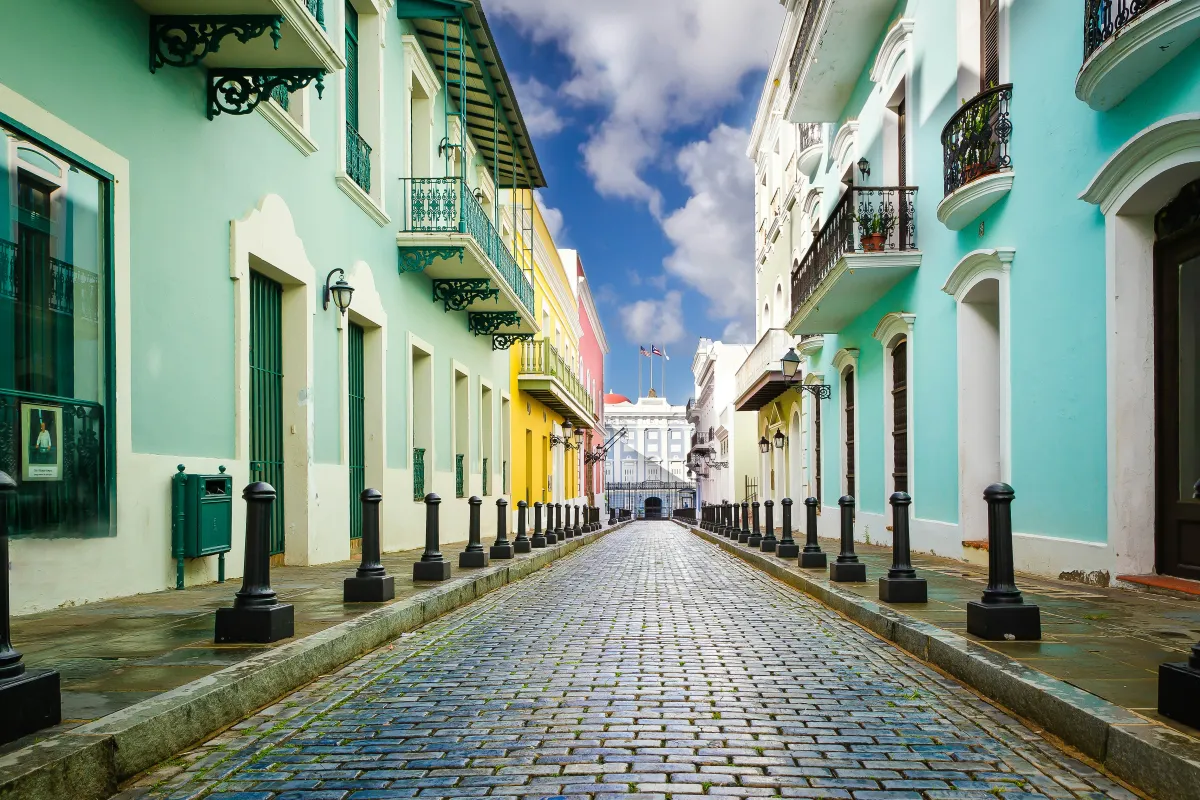 Photo: Puerto Rico, via lp-cms-production.imgix.net
This arrangement — full obligation, partial rights — is not an accident of constitutional ambiguity. It is a sustained political choice, renewed by inaction in every Congress that has declined to resolve it.
The Jones Act: A Century-Old Anchor Around Puerto Rico's Economy
No single piece of legislation better illustrates the extractive logic of Puerto Rico's relationship with the mainland than the Merchant Marine Act of 1920, universally known as the Jones Act. The law requires that all goods shipped between U.S. ports — including shipments between the continental United States and Puerto Rico — travel on vessels that are U.S.-built, U.S.-flagged, U.S.-crewed, and U.S.-owned.
The intent, a century ago, was to protect the American shipping industry. The effect, for Puerto Rico, has been to make nearly everything more expensive. Because the island imports the vast majority of its food, fuel, and manufactured goods, and because Jones Act-compliant vessels are significantly more costly to operate than foreign-flagged alternatives, Puerto Ricans pay a structural premium on basic necessities that economists have estimated at hundreds of millions of dollars annually. A 2012 study commissioned by the Federal Reserve Bank of New York found that the Jones Act added meaningfully to shipping costs for Puerto Rico compared to comparable Caribbean islands not subject to the restriction.
After Hurricane Maria devastated the island in September 2017, the Jones Act became a flashpoint. Aid organizations and foreign governments offered to send supply ships that could not legally dock under the act's provisions. The Trump administration issued a temporary waiver — but only after significant public pressure, and only for ten days. The waiver expired before the island's most acute supply shortages were resolved. The act remains fully in force today.
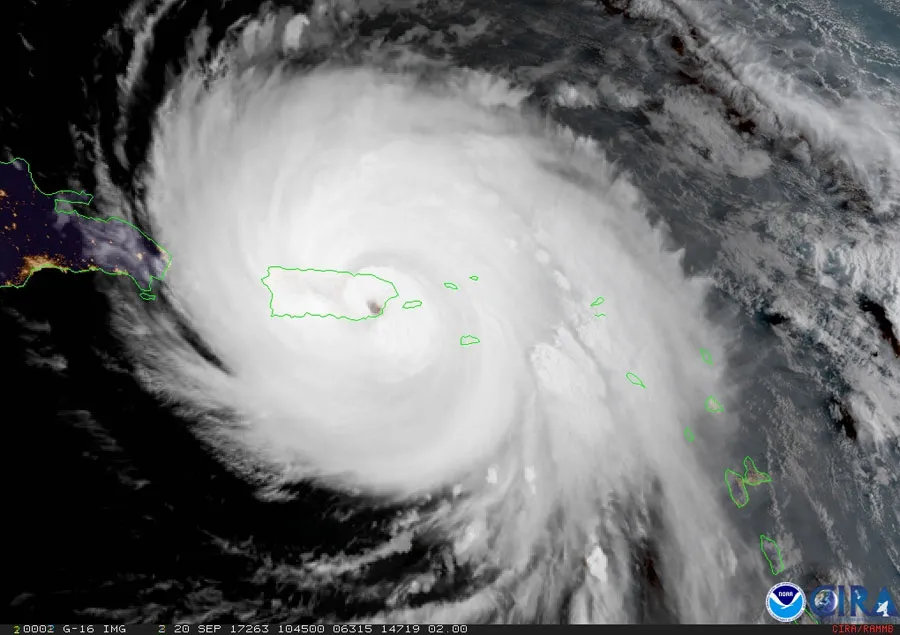 Photo: Hurricane Maria, via www.goes-r.gov
PROMESA and the Unelected Board That Governs an American Territory
In 2016, Congress passed the Puerto Rico Oversight, Management, and Economic Stability Act — known by the acronym PROMESA, the Spanish word for promise. The law created a seven-member Financial Oversight and Management Board, appointed by federal officials, with sweeping authority over Puerto Rico's budget, debt restructuring, and economic policy.
The board was created in response to a genuine fiscal crisis: Puerto Rico had accumulated more than $70 billion in public debt and an additional $50 billion in pension obligations, the product of decades of financial mismanagement, federal tax policy changes that gutted the island's industrial base, and recession-driven revenue collapse. A restructuring mechanism was necessary.
But the mechanism Congress chose was remarkable for what it revealed about Puerto Rico's status. The board — which Puerto Ricans did not elect, cannot remove, and have no formal democratic recourse against — has imposed austerity measures that have closed schools, cut pensions, reduced healthcare funding, and restructured public debt in ways that have consistently prioritized creditor recovery over resident welfare. When the Puerto Rican government has pushed back, the board has had legal authority to override it.
The strongest defense of the PROMESA board is that Puerto Rico's fiscal situation required external intervention — that the island's own political class had failed to manage public finances responsibly and that creditors needed a structured process to resolve the debt. This is not an entirely unfair point. Fiscal mismanagement was real, and unstructured default would have been chaotic.
But the counter is equally real: no state in the union that fell into fiscal distress would be subjected to an unelected federal board with override authority over its elected government. Detroit went through bankruptcy. Illinois has faced structural deficits for years. Neither was governed by an appointed federal oversight body that could veto legislative decisions. Puerto Rico received that treatment because it is a territory — because its residents lack the voting representation that would make such an arrangement politically untenable if applied to a state.
The Disaster Relief Disparity
Hurricane Maria made landfall on September 20, 2017, as a Category 4 storm. It killed an estimated 2,975 people — a figure the Puerto Rican government confirmed in 2018 after an independent study commissioned by George Washington University. It destroyed the electrical grid, contaminated the water supply, and caused an estimated $90 billion in damage.
The federal response was, by nearly every objective measure, slower, less resourced, and more administratively obstructed than the response to comparable mainland disasters. FEMA initially denied thousands of individual assistance applications at rates far higher than those seen after hurricanes Harvey and Irma, which struck Texas and Florida weeks earlier. Billions in congressionally approved recovery funds moved slowly or not at all: a 2020 report from the Center for Puerto Rican Studies found that years after the storm, large portions of approved Community Development Block Grant Disaster Recovery funds had not reached the island.
Then, in 2019, the Trump administration moved to claw back $8.2 billion in previously approved Medicaid funding for Puerto Rico — citing concerns about how the territory managed its healthcare system. The move was ultimately blocked by Congress, but the willingness to attempt it revealed the vulnerability of a population that cannot vote in federal elections and therefore has limited political recourse against federal decisions that harm them.
Why Neither Party Has Fixed This
The statehood question is often framed as a partisan issue, but the reality is more uncomfortable: both parties have used Puerto Rico's ambiguous status for their own purposes while declining to resolve it. Republicans have historically opposed statehood on the grounds that Puerto Rico would likely send Democratic senators and electoral votes to Washington. Democrats have offered rhetorical support for statehood without expending the political capital to advance it when they held congressional majorities.
The 2021 Puerto Rico Status Act passed the House but died in the Senate — the familiar graveyard for legislation that lacks filibuster-proof support. No serious effort was made to include Puerto Rican statehood in the reconciliation bills that moved through the 117th Congress.
For Puerto Rico's 3.2 million residents, this bipartisan inaction is not an abstraction. It is the lived experience of being American enough to pay federal taxes, serve in the military, and be subject to federal law — but not American enough to vote for the people who make those laws.
There is a word for that arrangement. It is not democracy. And the fact that it has persisted for 127 years does not make it any less a colonial relationship hiding in the grammar of American exceptionalism.